
FERS COLA Explained: How Your Pension Adjusts for Inflation — And Why It’s Less Than You Think
If you’re a federal employee approaching retirement, you’ve probably heard the term COLA — Cost-of-Living Adjustment. It sounds reassuring: your pension will keep pace with inflation. But here’s what too many federal employees discover only after they retire: if you’re under FERS, your COLA works very differently from what most people expect — and it’s almost always smaller than the headline inflation number you see in the news.
Understanding exactly how FERS COLA works — and where the gap comes from — is essential to building a retirement plan that doesn’t quietly lose purchasing power year after year.
What Is a COLA, and Why Does It Matter?
A Cost-of-Living Adjustment is an annual increase applied to your retirement annuity to help your income keep pace with rising prices. Without COLA, a pension that feels comfortable at retirement can erode significantly over a 20- or 30-year retirement. The federal government provides COLA to help retirees maintain their standard of living — but how much of an adjustment you receive depends on which retirement system you’re under.
How FERS COLA Is Calculated
FERS (Federal Employees Retirement System) COLA is tied to the Consumer Price Index for Urban Wage Earners and Clerical Workers (CPI-W), measured from the third quarter of one year to the third quarter of the next. OPM announces the COLA each October, and the adjustment takes effect the following January.
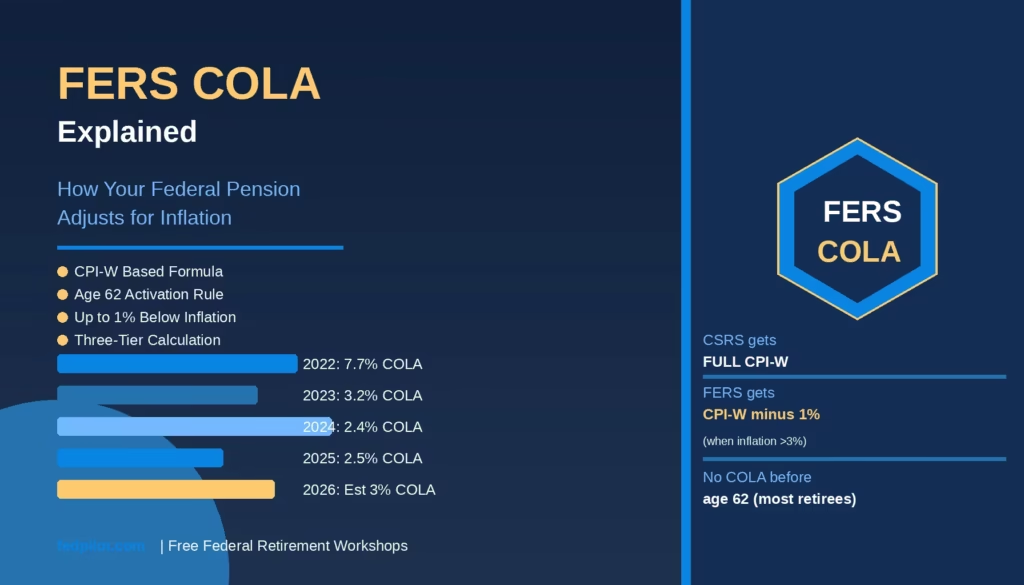
Here’s where FERS gets complicated: the adjustment you receive depends on the size of the CPI-W increase, using a three-tier formula:
- If CPI-W rises 2% or less: FERS retirees receive the full CPI-W increase.
- If CPI-W rises between 2% and 3%: FERS retirees receive a flat 2% — regardless of how high in that range the CPI-W lands.
- If CPI-W rises more than 3%: FERS retirees receive the CPI-W increase minus 1 full percentage point.
In practical terms, this means that in high-inflation years — exactly when you need the most protection — FERS retirees receive less relief than the actual rate of inflation. A 6% CPI-W year would translate to only a 5% FERS COLA. A 4% CPI-W year means only a 3% COLA.
Over a long retirement, that 1% annual shortfall compounds into a meaningful loss of purchasing power.
FERS vs. CSRS COLA: A Critical Difference
Employees under the older Civil Service Retirement System (CSRS) receive a full COLA equal to the actual CPI-W increase, with no reduction. CSRS retirees on full COLA are fully insulated from inflation in a way that FERS retirees simply are not.
If inflation averages 4% per year and you’re a FERS retiree, you’re effectively receiving a 3% COLA — falling behind by 1% each year. Compounded over 20 years, that gap is significant.
This isn’t a flaw or oversight — it’s an intentional design feature. FERS was built as a three-legged stool: your annuity, TSP, and Social Security working together. The expectation is that your TSP savings and Social Security benefits will help cover the inflation gap that your FERS pension doesn’t fully address.
Understanding this is critical, because it changes how you think about every leg of your retirement income.
The Age-62 Rule: When FERS COLA Starts
Here’s the part that surprises many FERS retirees: you generally don’t receive COLA at all until you turn 62. (Special Provision employees can receive it before 62.)
If you retire before age 62 — even if you’ve met your Minimum Retirement Age (MRA) and have 30 years of service — your FERS pension does not receive annual COLA adjustments until the January after your 62nd birthday.
There are exceptions to this rule:
- Disability retirees receive COLA at any age.
- Survivor annuitants receive COLA at any age.
- Special category employees — including law enforcement officers, firefighters, air traffic controllers, and Capitol Police — receive COLA at any age if they retire under a special retirement provision.
For most FERS employees, however, retiring at age 56 with 30 years of service means your pension stays frozen at its Day 1 level until you turn 62. If inflation runs at 3–4% annually during those years, your pension quietly erodes in real terms — even though the dollar amount on your check stays the same.
This is one of the most underestimated risks in FERS retirement planning.
What About the Special Retirement Supplement?
If you’re eligible for the Special Retirement Supplement (SRS), it’s worth noting that the SRS is not subject to COLA at all. It’s designed as a bridge benefit to approximate your Social Security benefit until you reach 62, but it doesn’t grow with inflation. This is another reason why your overall retirement income strategy — not just your pension — needs to account for inflation.
Social Security: Your Built-In Inflation Hedge
Social Security benefits receive their own COLA each year — and unlike FERS, Social Security COLA is the full CPI-W increase with no reduction. When you begin collecting Social Security (for most FERS employees this is somewhere between 62 and 70), that income stream starts receiving full inflation adjustments.
This is one reason why the timing of your Social Security claim matters so much for FERS employees. The longer you wait (up to age 70), the larger the monthly benefit — and the more purchasing power protection that full-COLA benefit provides for the rest of your life.
TSP and the Inflation Gap
Your Thrift Savings Plan is the third leg of the FERS stool — and it’s where you have the most control over inflation protection. Because the TSP is invested in market-based funds, growth in the C, S, and I Funds has historically outpaced inflation over long periods. Strategic TSP asset allocation and a thoughtful withdrawal strategy can meaningfully offset the purchasing power you lose when your FERS COLA falls short of actual inflation.
A common planning mistake is to retire with the TSP sitting heavily in the G Fund (the government securities fund) because it feels “safe.” The G Fund does preserve principal, but it typically won’t grow faster than inflation over time. For retirees who have decades of retirement ahead, that trade-off can be costly.
How to Plan Around the FERS COLA Gap
Given everything above, here are the key planning moves that can help FERS employees protect their purchasing power in retirement:
1. Don’t retire earlier than necessary without a plan. Every year before 62 is a year your pension earns no COLA. If you retire at 56 with a $3,000 monthly annuity, and inflation runs at 3.5% annually, your annuity’s real purchasing power falls to roughly $2,360 by the time you turn 62 — even though the check amount hasn’t changed. Know this going in and plan accordingly.
2. Treat TSP withdrawals as your inflation buffer. In early retirement years before Social Security kicks in, your TSP can be used to supplement your pension and bridge the purchasing power gap. Work with a financial professional to structure withdrawals so you’re not depleting the TSP faster than necessary.
3. Delay Social Security when possible. Waiting until 67 or 70 to claim Social Security doesn’t just give you a larger monthly benefit — it gives you a larger, full-COLA-protected benefit. That compounding matters enormously over a 25-year retirement.
4. Understand the difference between nominal and real income. A $4,000 monthly pension that grows at 2.5% COLA feels stable — but if inflation averages 3.5%, your real purchasing power still declines by 1% per year. After 20 years, that pension buys meaningfully less than it did on Day 1.
5. Attend a free workshop. The interaction of FERS pension, TSP, and Social Security is genuinely complex — and how you sequence and coordinate these income streams has a real dollar impact on your retirement quality. Fed Pilot’s free federal retirement workshops walk you through all of this in plain language, with real scenarios built around your actual benefits.
The Bottom Line on FERS COLA
FERS COLA is real and valuable — but it’s designed to work alongside TSP and Social Security, not to stand alone as your only inflation protection. Knowing how the three-tier formula works, understanding the age-62 trigger, and planning for the years when your pension receives no COLA at all are the foundations of a retirement that actually stays comfortable over time.
The federal retirement system gives you powerful tools. The key is knowing how to use them together.
Ready to see how FERS COLA fits into your overall retirement picture? Register for a free Fed Pilot workshop — available as a live webinar or in-person event near you. Our educators walk you through your complete benefits package so you retire with confidence, not questions.


