
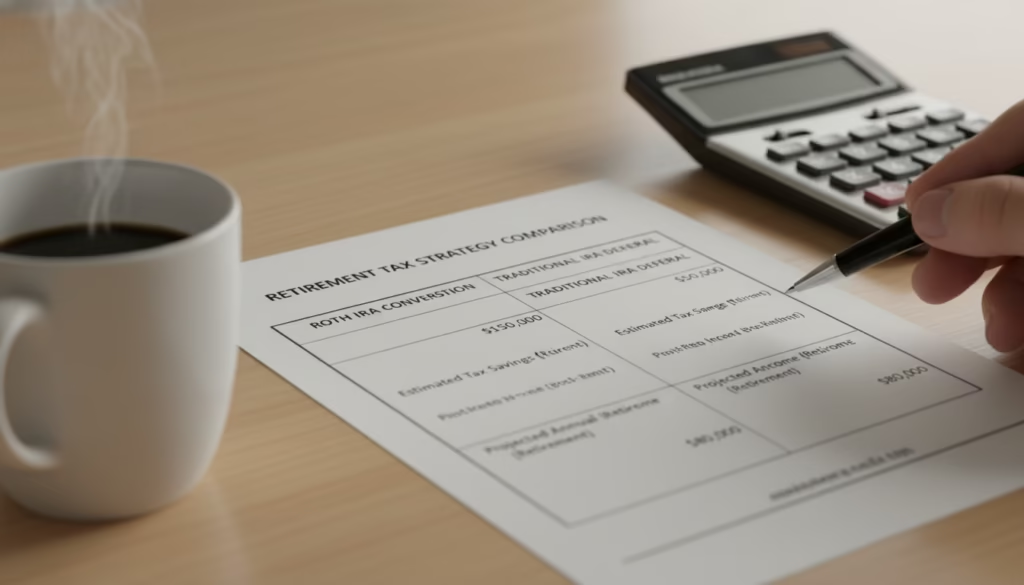
Roth TSP vs. Traditional TSP: What Federal Employees Need to Know in 2026
Roth conversions have become one of the most talked-about strategies in federal retirement planning. A recent piece in Government Executive put it plainly: many federal employees may want to slow down before converting — because rushing into a Roth strategy without understanding your full tax picture can cost more than it saves.
Here’s what the Roth vs. Traditional TSP decision actually comes down to for federal employees.
The Core Difference: When You Pay Taxes
This is the only real difference between Roth and Traditional TSP — everything else flows from it.
| Traditional TSP | Roth TSP | |
|---|---|---|
| Contributions | Pre-tax (reduces taxable income now) | Post-tax (no immediate tax benefit) |
| Growth | Tax-deferred | Tax-free |
| Withdrawals in retirement | Taxed as ordinary income | Tax-free (if rules met) |
| Best if taxes are… | Higher now than in retirement | Lower now than in retirement |
The Key Question: Will Your Tax Rate Be Higher or Lower in Retirement?
This is the question that determines everything — and it’s harder to answer than it sounds for federal employees specifically.
In retirement, your income will likely include your FERS pension, TSP withdrawals, and eventually Social Security. For many federal employees, especially those at GS-12 and above, this combined income keeps them in a meaningful tax bracket in retirement — sometimes not much lower than their working years.
Add to that: up to 85% of your Social Security benefit may be taxable depending on your combined income, and required minimum distributions (RMDs) from Traditional TSP kick in at age 73, which can push income higher than expected.
Why Federal Employees Are Different From the General Advice
Most general financial advice about Roth vs. Traditional is written for private sector workers with no pension. Federal employees have a fundamentally different retirement income structure — a guaranteed pension income stream that continues regardless of market performance.
That pension income means your “floor” in retirement is higher than most people’s. Which means:
- Your retirement tax bracket may not drop as much as you expect
- RMDs on top of pension income can push you into a higher bracket than anticipated
- Tax-free Roth withdrawals become more valuable when your other income sources are already fully taxable
The 2026 Roth In-Plan Conversion — What’s New
The TSP now allows in-plan Roth conversions — converting existing Traditional TSP balances to Roth within the TSP itself. This is a relatively new option and one worth understanding carefully before using.
The important detail: when you convert Traditional TSP funds to Roth, you pay income tax on the converted amount in the year of conversion. Converting a large balance in a single year can push you into a significantly higher tax bracket. A “ladder” approach — converting smaller amounts across multiple years — often makes more sense than converting a large lump sum at once.
The Five-Year Rule — Don’t Skip This
Roth TSP withdrawals are only tax-free if two conditions are met: you’re at least 59½ and it’s been at least five years since your first Roth TSP contribution or conversion. If you’re planning to retire in fewer than five years and haven’t started Roth contributions yet, that clock matters.
A Simple Framework for the Decision
- Earlier in your career, lower income now: Roth contributions often make sense — you’re in a lower bracket today and have decades of tax-free growth ahead.
- Peak earning years, higher income now: Traditional contributions may make more sense — the pre-tax deduction is more valuable when you’re in a higher bracket.
- Near retirement with a large Traditional balance: Gradual Roth conversions over several years may reduce lifetime tax burden — but run the numbers with your full retirement income picture first.
Understand How TSP Fits Into Your Full Retirement Tax Picture
We cover Roth vs. Traditional TSP, in-plan conversions, and withdrawal strategy in our free workshop — in the context of your full federal retirement income picture. No products. No sales. Just the information you need to make a smart decision.
Rated 4.9/5 stars · 20,000+ federal employees attended · 20+ years of experience
Sources: Government Executive, March 2026; tsp.gov. This article is for educational purposes only and does not constitute financial, legal, or retirement advice.